
⚡ What You Need to Know — Quick Summary
|
Here’s what most landscaping companies won’t tell you: there is no single price for a commercial spring cleanup. A small retail strip center and a 5-acre HOA common area are both “commercial properties”, but they have almost nothing in common when it comes to scope and cost.
Rather than throw out a number that doesn’t apply to your property, we’re going to walk you through the real factors that drive cost so you can understand exactly what you’re paying for and make a smarter buying decision, whether you hire Puryear Farms or anyone else.
At Puryear Farms, we’ve been serving commercial properties across Gallatin, Hendersonville, White House, Portland, and the rest of Sumner County since 1989. This is what we see in the field every spring.
In this article:
- What’s included in a commercial spring cleanup
- The 9 real cost drivers & what moves your price up or down
- Mulch depth math: a real example on a 1,000 sq ft bed
- Mulch type comparison table
- The counterintuitive truth about plant density and cost
- Red flags to watch for when hiring a commercial landscaper
- What to expect working with Puryear Farms
What’s Typically Included in a Commercial Spring Cleanup?
A thorough spring cleanup is a package of interconnected services and each one sets the next up for success. Here’s what a full-service scope covers:
Debris Removal
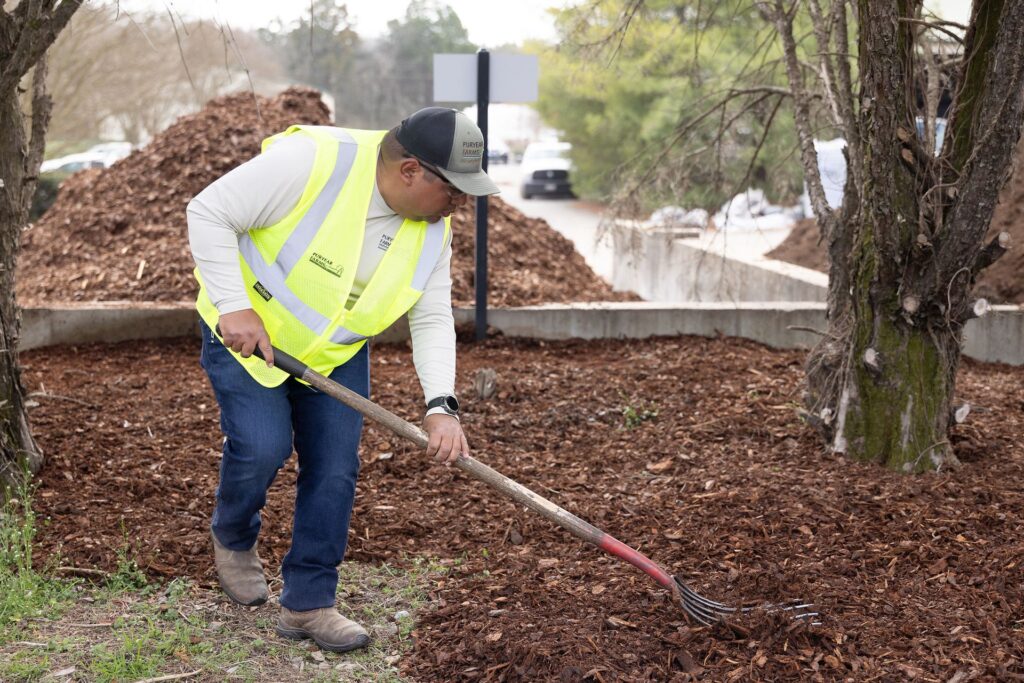
Winter leaves behind leaf litter, downed branches, and accumulated debris in beds and turf areas. Clearing this out first is non-negotiable. Mulching over debris traps moisture, promotes fungal issues, and looks sloppy within weeks.
Bed Edging & Cleaning
Clean, crisp bed edges are one of the most visible signals that a commercial property is professionally maintained. This means re-cutting lines along walkways and turf borders, pulling winter weeds, and prepping beds to receive fresh mulch. It’s front-end work and on neglected properties, it’s often where the most time is spent.
Mulch Installation
Fresh mulch retains moisture, suppresses weeds, regulates soil temperature, and gives your property an immediate visual upgrade. It’s one of the highest-ROI line items in commercial landscaping and one of the most variable in cost. We break this down in detail below.
Pruning & Trimming
Ornamental shrubs, grasses, and perennials need to be cut back before new growth pushes through. One important timing note: we typically mulch first, then return for a spring-prune event after the spring flush. If you’re expecting pruning at the same visit as mulching, clarify this with your provider upfront. See our guide to proper pruning timing in Tennessee for more on why timing matters.
Pre-Emergent & Fertilizer Application
Spring is the window to apply pre-emergent weed control before crabgrass and summer annuals germinate. This step is time-sensitive — miss the window and you’re playing catch-up all season. For more on turf health timing, see our guide to commercial turf health care for Gallatin property managers.
What Actually Drives the Cost of a Commercial Spring Cleanup?
These are the variables that determine whether your cleanup costs closer to $1,000 or $10,000. Understanding them helps you evaluate any quote more accurately.
-
What type of mulch costs the most for commercial properties?
Not all mulch is equal, and the difference shows up on the invoice. Standard hardwood mulch, premium dyed mulch (brown or black), pine bark, and pine straw all carry different price points per yard. Premium dyed mulch can run 30–50% more than standard hardwood. The type you choose, or your provider recommends, is one of the biggest material cost variables on any cleanup job.
See the mulch type comparison table below for a side-by-side breakdown.
-
How does mulch depth affect the cost of a spring cleanup?
This is one of the most overlooked cost drivers. The difference between a light refresh and a proper installation is significant — both in performance and in price.
Real Example: 1,000 Square Foot Bed
| Scenario | Depth | Cu. Yards Needed* | Notes |
| Light annual refresh | 1 inch | ~3.1 cu yds | Maintained yearly |
| Standard maintained bed | 2 inches | ~6.2 cu yds | Recommended minimum |
| New or neglected bed | 2.5 inches | ~7.7 cu yds | Full coverage required |
*Formula: (sq ft × depth in inches) ÷ 324 = cubic yards. Material and labor costs multiply from there.
If your beds are maintained every year, a 1-inch refresh may be sufficient. If beds are new or the previous mulch has fully decomposed, expect a 2 to 2.5-inch application — more than double the material for the same square footage.
Also ask your provider: are they removing old mulch first, or applying on top? Removal + full new layer = higher cost. On-top application = lighter dusting. Make sure both approaches are quoted apples-to-apples.
-
Does pine straw cost more than hardwood mulch annually?
Yes — when you factor in annual application frequency. Hardwood mulch (brown, black, or pine bark) is typically applied once per year.
Pine straw needs to be refreshed twice per year to maintain adequate coverage. If your property uses pine straw, budget for two applications annually versus one for hardwood. Over a full season, that difference adds up significantly, especially on larger properties.
-
How does site access affect commercial landscaping costs?
Can a full-size mulch truck pull close to where the material needs to go? Or does your property have gated access, narrow drive lanes, or areas that require material to be wheelbarrowed long distances?
Access directly affects labor time, and labor is the primary cost driver in commercial landscaping. Properties with open, easy access are faster and less expensive to service than campus-style or gated properties with multiple separated areas.
-
Does the job require a mulch-blowing truck?
For large properties with extensive bed areas, a mulch blowing truck — which pneumatically delivers material up to 200 feet — can save significant time versus hand installation.
But not every landscaping provider owns this equipment. If your provider subcontracts the mulch blowing, that cost gets passed to you.
-
What front-end work is required before mulch can go down?
Mulch doesn’t go on a dirty bed. The question is how much prep is needed to get there. Are the beds full of winter weeds? Are the edges grown over? Has old mulch matted into a thatch that needs to be broken up or removed? Is a pre-emergent and fertilizer application in scope?
These front-end actions such as edging, weeding, cleaning, pre-emergent, can represent as much of the total cost as the mulch itself on a heavily neglected property.
On a well-maintained property with regular service, this prep is minimal.
-
Does your booking date affect the price of a spring cleanup?
Yes. Spring in Middle Tennessee is a short window, and commercial crews fill up fast. Clients under a maintenance contract or who schedule in January and February lock in earlier dates and more scheduling flexibility. Clients who call March 1st asking for spring cleanup in two weeks are competing for remaining slots — and may pay more for it, or simply not get the dates they need.
Planning ahead is one of the simplest ways to reduce your cleanup cost. Learn more about our full landscape maintenance services in Gallatin.
-
What should I do about chronic mulch washout areas on my property?
If you’re paying to remulch a slope or drainage channel every season, that’s a recurring cost with a better long-term fix. Replacing a chronic washout area with river cobble or another hardscape solution is a one-time investment that eliminates the expense permanently.
If standing water or drainage issues are also a factor, see our overview of smart drainage solutions for Tennessee properties. A good commercial partner will flag these issues proactively — even when it costs them a recurring job.
-
Does more plant material in a bed mean a higher mulch cost?
Counterintuitively — no. And this surprises most commercial property managers.
Mulch is priced by coverage area. A mature landscape with dense, established shrubs has less open bed to cover — the plants themselves take up the square footage. A new bed or one with sparse plantings requires mulch across the full open area.
The flip side: mature, dense plantings require more pruning time and more detailed cleanup around each plant. So the pattern looks like this:
| Landscape Maturity | Mulch Cost | Pruning Cost |
| Newer / sparse beds | Higher (more open ground) | Lower |
| Mature / dense plantings | Lower (plants fill the bed) | Higher |
Understanding this trade-off helps you evaluate quotes more accurately. A higher mulch number on a new property isn’t padding — it reflects actual open square footage.
Mulch Type Comparison: Which Is Right for Your Commercial Property?
| Mulch Type | Cost Tier | Applications/Year | Best For | Notes |
| Standard Hardwood | $ | 1×/year | Most commercial beds | Most common choice |
| Dyed Brown/Black | $$ | 1×/year | High-visibility entrances | 30–50% premium over hardwood |
| Pine Bark | $$ | 1×/year | Acid-loving plants | Lighter; can float in heavy rain |
| Pine Straw | $–$$ | 2×/year | Sloped areas, naturalistic beds | Lower per-app; higher annual total |
Note: Cost tiers are relative. Your actual quote depends on bed square footage, depth, and prep work required. Ask your provider to quote each mulch type so you can compare apples to apples.
Red Flags to Watch For When Hiring a Commercial Landscaper for Spring Cleanup
Not all bids are created equal. Here’s what experienced property managers watch for and what should make you ask more questions before signing:
🚩 Red Flags to Watch For When Hiring a Commercial Landscaper
|
Why Commercial Properties Across Sumner County Work with Puryear Farms
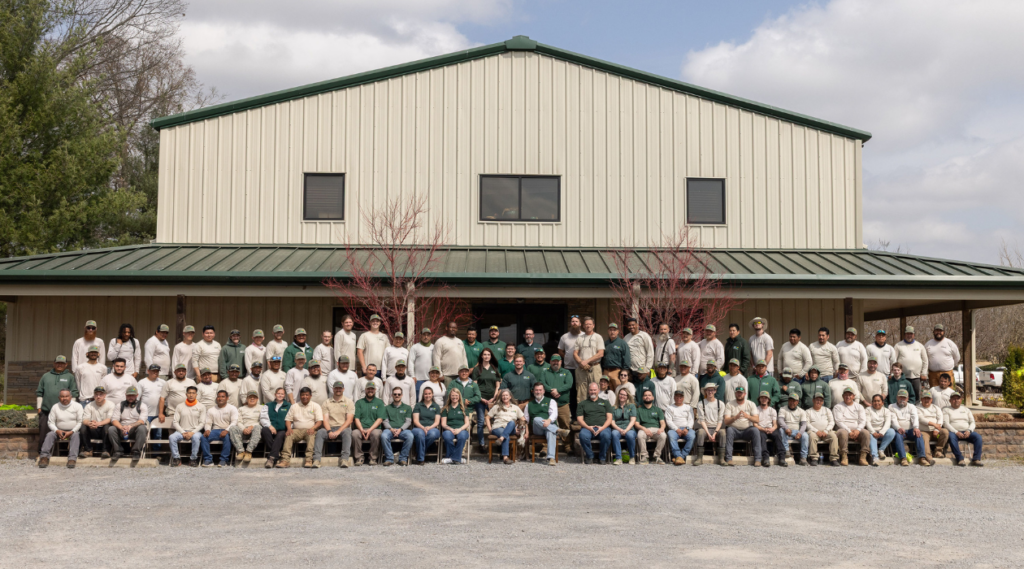
We’ve been a part of this community since 1989. Here’s what our commercial clients consistently tell us matters most:
- Family-owned and local — we’re your neighbors, not a national franchise. Our reputation is on every property we touch.
- One crew does it all — no subcontractors on your job site, no coordination problems, no finger-pointing if something goes wrong.
- Consistent scheduling — you’ll see the same faces, and work gets done when we say it will.
- Licensed & insured — fully covered for commercial work.
- Free, itemized estimates — no commitment required, and no vague lump-sum quotes.
- 100-truck fleet — the equipment and capacity to handle commercial properties of any size.
We serve HOA communities, office parks, retail centers, and industrial campuses throughout all of Sumner County — Gallatin, Hendersonville, White House, Portland, Westmoreland, and Goodlettsville.
Looking to upgrade your commercial entrance this spring? See our guide to spring flowers and seasonal color for commercial entrances in Tennessee.
Ready to Get an Accurate Quote for Your Property?
The best way to know exactly what your spring cleanup will cost is a quick walkthrough of your property. We’ll give you a clear, itemized estimate — broken down by service so you can see exactly what you’re paying for.
| Call or text Puryear Farms to schedule your free commercial estimate. Spring books fast — reach out soon for the best availability. |
Frequently Asked Questions
How much does commercial mulching cost per yard in Tennessee?
Mulch installation cost depends on material type, bed access, depth required, and whether front-end work (edging, weeding, pre-emergent) is included. Standard hardwood is the most affordable; premium dyed or pine bark runs higher. A per-yard material cost alone doesn’t reflect the full scope — always ask for an all-in, itemized quote that includes prep work.
How early should I schedule a spring cleanup for my commercial property in Gallatin, TN?
January or February is ideal. Spring is a compressed season in Middle Tennessee, and commercial crews book up quickly. Pre-emergent applications are also time-sensitive — they need to go down before soil temperatures rise past the germination threshold, typically by late March. Booking early gives you the best dates and the most flexibility.
Does Puryear Farms charge by the hour or by the job for commercial cleanups?
By the job. You know your total cost upfront — no hourly surprises. Our estimates are itemized so you can see exactly what each service costs before you commit.
What is the difference between pine straw and hardwood mulch for commercial properties?
Hardwood mulch is applied once per year; pine straw needs to be refreshed twice per year to maintain adequate coverage. Pine straw may have a lower per-application cost, but the twice-annual frequency makes it a higher total annual investment on most commercial properties. The right choice depends on your aesthetic preference, plant types, and bed conditions.
What should be done before mulch is installed on a commercial property?
Beds should be edged, weeded, and cleaned before any mulch goes down. Pre-emergent and fertilizer applications, if included in the scope, should also be applied before or alongside mulch installation — not after. Front-end prep is what separates a professional mulch job from a cosmetic cover-up.
Do you serve commercial properties outside of Gallatin, TN?
Yes. Puryear Farms serves commercial properties throughout all of Sumner County, including Hendersonville, White House, Portland, Westmoreland, Goodlettsville, and surrounding areas in Middle Tennessee.